
A strong follow up email after an inquiry thanks the person, repeats the problem they asked about, adds one useful detail that supports your page’s promise, and gives them one easy next step. The hard part is knowing that your website made a good first impression, then worrying that a stiff or rushed reply will make you sound like somebody else.
That fear is real when your work is personal and the person has trusted you enough. This article shows how to make your reply feel like the next page of the same story, not a handoff to a cold inbox.
What should an inquiry reply do first?
Your first reply should confirm the person’s situation and tell them what happens next.
Picture a consultant who fills in your contact form after reading a page about unclear offers. They have already spent time deciding whether your problem sounds like theirs, so an email that says only “Thanks for your inquiry” makes them start that work again.
Instead, pick up the thread they began. Name the service, page, or concern they mentioned, then show that you understand the decision in front of them. For example, if they asked about unclear offers, name that concern and say what you would look at first, rather than sending a generic thank-you or booking link.
A useful first reply has four parts:
- Thank them for the specific action they took. Mention the service or problem they asked about.
- Reflect the problem in plain language. Use their words where you can, without copying the whole form back to them.
- Give one helpful piece of direction. This might be what you need from them, what you will send, or what usually needs looking at first.
- Offer one next move. Make it small enough to answer from a phone.
Thin reply: Thanks for reaching out. When are you free for a call?
Story-carrying reply: Hi Maya, thanks for asking about making your offer easier for referrals to understand before they call. I can see why that matters when people like your work but still leave your site unsure where to start. If you send me the page you share most often, I will tell you which part I would check first.
The second note does not make a big promise. It simply continues the same care the reader saw on the page.

Why can a fast reply still feel wrong?
A fast reply feels wrong when speed removes the detail that made the inquiry personal.
People often hear that they should answer every lead at once, and quick replies do matter because the person still remembers why they reached out. Current guidance from Zapier and Cyberimpact supports prompt, automated acknowledgment after an inquiry, especially when you cannot reply in full straight away.
Still, speed is not the same as pressure. A reply sent in two minutes can sound careless if it ignores what they asked, while a short note that says when they will hear from you can protect trust when you are with a client or away from your desk.
Use this rule: send a real acknowledgment as soon as you can, then send the helpful answer when you have the attention to give it properly.
When you can answer fully now: respond with their concern, one useful point, and a next step.
When you need more time: confirm you received the message and name the time they can expect a full reply.
Hi Jordan, I saw your note about your website getting visits but not enough inquiries. I am in client work this afternoon, but I will read your page and reply by 10 a.m. tomorrow with the first thing I would look at.
That timing line matters because a person should not have to wonder whether their message disappeared.
Some marketing articles repeat dramatic response-time figures, but the source trail behind those numbers is often unclear. The safer lesson is simple: reply promptly, be specific, and set a clear expectation when a fuller answer must wait.
How do you continue the story your page began?
Continue the story by answering the next question your page naturally creates.
A good page starts a line of thought. It may help a coach see why clients hesitate, help a consultant name an offer problem, or show a service owner that their best proof is trapped in past work. Once that person inquires, they are usually carrying one question forward: “Does this fit my case?”
Your email should meet that question rather than jump straight to your calendar.
| Where the person is | What they need next | What your reply can do |
|---|---|---|
| They read your page | “This sounds familiar.” | Confirm you heard the same problem. |
| They sent an inquiry | “Could this help me?” | Explain what you would look at first. |
| They are considering a call | “What would happen?” | Give a clear picture of the first conversation. |
| They have gone quiet | “Is this worth returning to?” | Send one useful answer, not another demand. |
A page can speak in a calm, useful voice, but the email can become a copied sales note with a booking link and no context. The reader is left to decide whether the warmth on the page was real.
If your page says you help people make a hard decision, do not reply with a long list of packages. Explain the first decision you would help them make. If your page says you make a service easier to understand, ask for the one page or sentence they find hardest to explain.
The 5-Step Website Copy Blueprint for Building Trust Fast with Visitors can help you check whether your page gives the inquiry a clear starting point. Your reply works best when the visitor already knows who you help, why the problem matters, and why the first step is worth taking.
What details make an inquiry email feel personal?
Personal follow-up uses the person’s real context, not a greeting that pretends you already know them.
You do not need a long paragraph or private details to make an email feel personal. One true detail from their inquiry is enough when it changes the help you offer next.
Use details such as:
- The service they asked about and the page where they found it.
- A problem they named, such as referrals who still need an explanation.
- The result they are trying to create, like a clearer offer before a launch.
- A limit they mentioned, including a deadline, a small team, or a need to stay in charge.
- A question they asked that deserves a direct answer before a call.
Avoid false personal touches. Writing “I hope you are well” is harmless, but it does not tell a busy person why this message belongs in their inbox. Using their first name five times does not create care either.
Hi [Name], thanks for explaining that [specific problem]. You said [short detail from their message], which usually points to [one clear issue to explore].
The first thing I would want to see is [concrete item], because that will show whether [plain reason]. If you send it over, I can tell you what I notice. If you would rather talk it through, reply with two times that work for you this week.
The reader has a choice, and both choices make sense after the page they read.
Should you send a booking link right away?
Send a booking link right away only when the inquiry shows the person is ready to discuss their case.
A direct booking link is useful when someone asks about dates, price, availability, or a clear project. It becomes a barrier when somebody has just asked a broad question because they still need a little help making sense of the problem.
A ready inquiry: “I need help improving our service page before a January launch. Do you have room next week?” They need availability and a clear call option.
An early inquiry: “My website does not seem to bring in the right people. Can you help?” They need a short question that narrows the problem before you ask for their time.
Give the early inquiry a decision rule:
- Ask for a call when they have named a project, timing, or decision they want help with.
- Ask for one small detail when the problem is still wide.
- Send a useful resource when they need to understand the issue before discussing help.
For a person whose website feels unclear but who cannot yet say why, the free [Trust Scorecard](#trust-scorecard) gives them a way to spot gaps in fit, proof, and the next step. The Magnetic Growth System uses the answers from that kind of review to turn your business details into connected pages and follow-up, so a lead sees the same clear message at every point.
A booking link can sit below your helpful answer. It should not replace the answer.
What should your first full reply say?
Your first full reply should make the person feel understood and make one next choice easier.
Use this five-part draft when you are replying to an inquiry about your service:
Subject: Re: [their topic]
Hi [Name],
Thanks for getting in touch about [their topic]. You mentioned [specific situation], and that can be frustrating when [real cost or concern].
From what you shared, I would first look at [one item], because it can show whether [plain explanation].
You can reply with [one easy detail] and I will point you in the right direction. If you already know you want to talk it through, you can choose a time here: [link].
Best,
[Your name]
Keep it short enough that the main point is visible without scrolling. The email has one job: carry the reader from interest into a useful conversation.
A person who has just inquired usually needs less information, not more. Give them the next answer, then let their reply tell you what belongs after it.
What should you avoid in an inquiry response?
Avoid anything that makes the person repeat themselves or manage your urgency.
These are common warning signs:
- A copied answer with no reference to their question. It tells them the form did more listening than you did.
- A calendar link with no explanation. They may not know what the call is for or whether it is worth booking.
- A long sales pitch. The person asked for a bridge, not a brochure.
- Several different actions. One email should not ask them to book, download, follow, read, and reply.
- A promise you cannot keep. Say what you can review, explain, or send rather than implying you can solve the whole problem by email.
- A vague close. “Let me know” leaves the person with no clear action.
Campaign Monitor’s copywriting guidance stresses that email works best when the reader can quickly see the purpose and action. That does not mean every email needs a button; it means your request should be easy to understand in one read.
The first reply is evidence of how you work when someone raises their hand.
How do you build the reply into a short trust path?
Build the reply as message one in a small sequence, not as a one-off note.
An inquiry does not always lead to a same-day decision. A service buyer may need to check budgets, speak with a partner, review a page, or decide whether the problem is urgent enough. Your follow-up should give them new help as they make that choice.
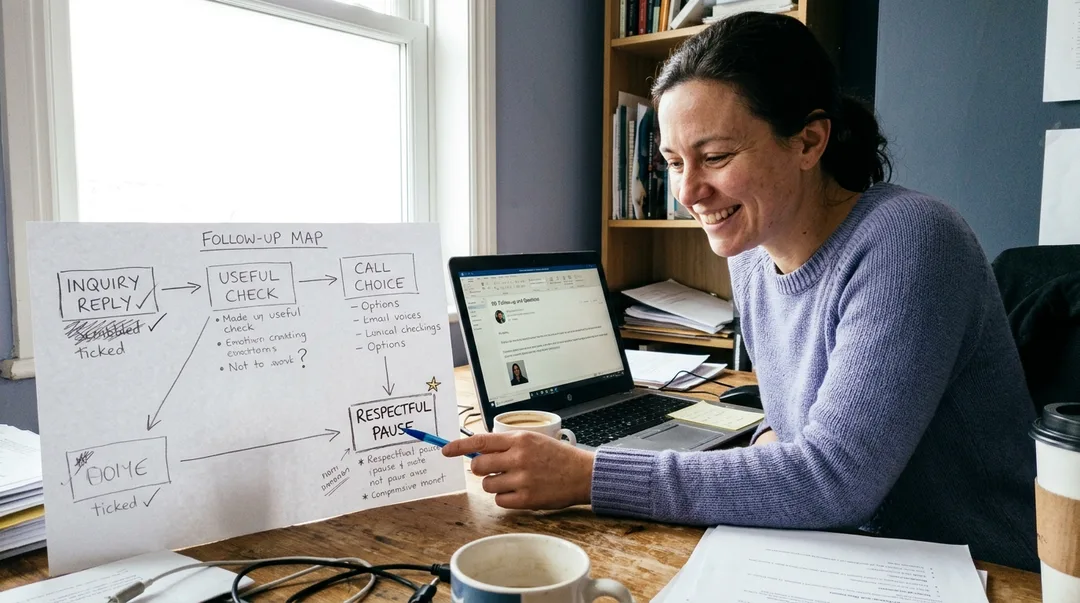
A simple path can look like this:
- Day 0: Reply with context. Confirm what they asked and offer one fitting next step.
- Day 2: Add one useful lens. Send a short check they can use on the problem they named.
- Day 5: Show the path. Explain what happens in a first call or review, so the unknown feels smaller.
- Day 9: Offer a choice. Let them take the Trust Scorecard or reply to discuss their case.
- Day 14: Pause with respect. Tell them you will step back and leave a clear way to restart later.
Each message should bring a fresh reason to read. Repeating “Just checking in” makes the lead carry the whole conversation, while a useful next answer shows you understand that careful decisions take time.
For a wider message plan, read How to Follow Up With High-Ticket Leads Without Sounding Desperate. It maps five different jobs for five messages, so you are not sending the same ask in different clothes.
How can you tell whether your reply carries your brand story?
Your reply carries your brand story when it sounds like the promise the person just read.
Read your page opening and inquiry email side by side. Look for the same three things: the problem you name, the way you explain it, and the kind of next step you offer. They do not need identical wording, but they should feel like one person wrote both.
In 12 years of online growth work, I have seen that leads often go quiet when the message changes after they inquire. A clear page earns trust by showing care and focus, then a generic reply can make the next step feel risky again.
I have also seen this across work with more than 600 service businesses: the best follow-up messages do not try to force a decision. They make the decision easier by adding one useful detail at a time.
If your replies keep sounding different from your website, start with the source material rather than hunting for a better email template. The Magnetic Growth System captures your offer, client language, proof, and point of view, then uses that foundation to help your pages and follow-up stay connected. Get your free [Trust Scorecard](#trust-scorecard).
A good inquiry reply does not need to close the sale. It needs to make the person feel that contacting you was a sensible next move, and that is the real work of a follow up email after an inquiry.
Frequently asked questions
What should I say after an inquiry?
Thank the person, name the problem or service they asked about, and give one useful next step. Keep the reply short enough to read on a phone. Ask for one small detail or offer a call only when it fits their question.
How soon should I reply to an inquiry?
Reply as soon as you can during your workday, while the person still remembers reaching out. If you cannot give a full answer yet, send a short note that confirms you received it and says when you will reply properly. Clear timing builds trust.
Should I send a booking link immediately?
Send a booking link when the person asks about a clear project, price, timing, or availability. If their question is broad, answer one part of it first and ask for a small detail. A calendar link should support your reply, not replace it.
How do I make an inquiry reply personal?
Use one real detail from the person's message, such as the page they need help with or the problem they named. Explain what you would look at first and why. Personal follow-up means relevant help, not using their name again and again.
What if I need more time to answer?
Send a brief acknowledgment with a real reply time. Say what you saw in their message, then tell them when they can expect your full response. This keeps them from wondering whether their inquiry was lost in your inbox.
How do I follow up after no reply?
Send a useful message that gives them a new reason to return, such as a short check, a clear example, or a choice between two next steps. Do not repeat the same request for a call. After a respectful pause, leave an easy way to restart later.
How can my follow-up match my website?
Read your page and email side by side. They should name the same problem, use a similar tone, and offer a next step that feels connected to the page. The Magnetic Growth System helps turn your offer, proof, and client language into pages and follow-up that stay consistent.