
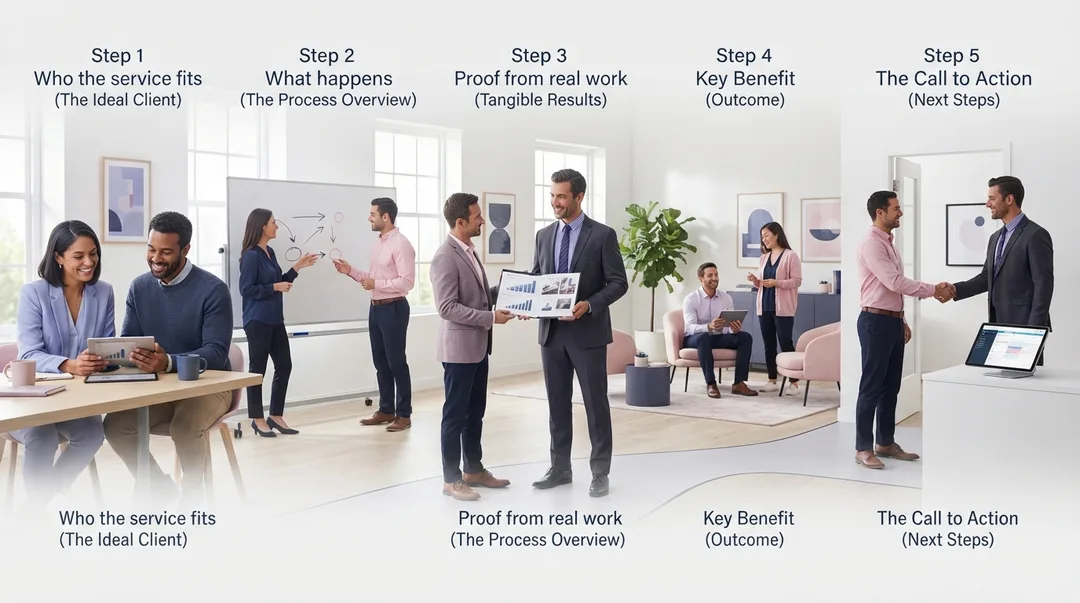
When you are working out how to write a service page, the fear is that your words will sound stiff, pushy, or far smaller than the work you do. That fear often shows up when you know you can help but cannot see how to say it on a screen. A good service page shows the right person that the work fits them, proves you can help, and gives them one clear next move. In about two focused hours, you can build a first draft that does all three.
The page is not there to tell your whole story; it is there to help a visitor decide whether they should keep reading, trust what they see, and take a small step.
What will your finished service page do?
A clear service page answers three things: fit, proof, and next step.
A visitor should know within a few lines whether you help someone in their spot, what may change through your work, and what happens if they want to talk. If they have to hunt for those answers, even strong work can feel hard to choose, so your finished page needs these parts:
- A clear opening. Name who the service is for and the problem it helps with.
- A plain result. Show the change your client is working toward.
- A simple path. Explain what working together looks like.
- Real proof. Give a reason to believe your words.
- One action. Tell the visitor what to do next.
This fit-proof-next step structure lets people see themselves in the page before they care about your process.
In my work helping more than 600 service businesses build trust online, the strongest pages made the visitor’s decision easier.
What do you need before you start?
Start with real client words, not polished marketing lines, because you need a few notes before writing or the page will become a list of services and broad claims. Open a document and answer these questions as if a good client were sitting across from you.
- Who gets the most value from this service?
- What has happened that makes them seek help now?
- What does that problem cost them in their day-to-day work or life?
- What useful change can your work help them make?
- What happens from the first conversation to the end of the service?
- What proof can you share with permission?
- What is the best first step for a person who is interested but careful?
Keep your answers concrete: “I help leaders grow” leaves you with nothing useful to write, while “I help new managers handle hard team talks without putting them off for weeks” gives the page a real person and a real moment.
You are choosing the focus for one page, not limiting your whole business.
How do you show who the service fits?
Lead with the person and problem, not your business name, because many service pages open by talking about the owner, the company, or a wide promise. The visitor has arrived with a problem of their own, so meet them there first.
Write an opening that joins three simple parts:
I help [person] who are dealing with [hard moment] and want [clear change].
A coach might write, “I help busy business owners who know what they need to do but cannot stay steady with it alone.” A consultant might write, “I help service firms whose client work is strong but whose offer is hard to understand online.”
Then add one short line that explains the service in everyday words and avoid labels that need explaining, such as “high-level transformation” or “strategic support.”
A visitor should be able to check fit without guessing; if your first section could fit almost any business, narrow it until it feels like it belongs to a real person.
How specific should the opening be?
Use the detail your best client would notice; you do not need to name every age, job title, or life stage. The useful detail proves you understand the problem. A service owner who gets referrals but freezes when asked, “What exactly do you do?” will recognise that line far more than “businesses ready for growth.”
How do you explain what changes?
Show the move from the hard moment to a useful result, because before a visitor asks how you work, they want to know what the work is for.
Write the change in a before-and-after pair:
- Before: Their offer is hard to explain, so good prospects leave unsure.
- After: They have clear words for the problem they solve and the help they offer.
- Before: They keep reacting to the same issue in their team.
- After: They can spot the pattern and take a calmer next action.
- Before: Their marketing feels like a task waiting for them late at night.
- After: They have a clear page that reflects the quality of their work.
Stay close to what you can honestly help create, whether helping a client gain clarity, make a plan, build a skill, or prepare for a decision. Claims about money, sales, or guaranteed outcomes make careful visitors less likely to trust the rest of the page.
The better choice is copy a client can picture and later recognise as true.
How do you describe the service without overloading the page?
Give the visitor a short path they can picture, since a page with no process can feel vague, while a page that explains every tool and call can feel like homework. Use three or four steps that show what the client will experience.
- Begin with what is happening now. Explain what you look at together, such as their current challenge, message, or goal.
- Choose the main focus. Show how you decide what needs attention first instead of trying to fix everything at once.
- Do the work in a clear way. Name the useful activity, whether that is coaching, review, planning, feedback, or hands-on support.
- Leave with a next move. Tell them what they will have, know, or be ready to do after the service.
Use words a visitor can see in their mind: “We start by looking at the points where your offer becomes unclear, then shape the words a new visitor needs first” is easier to trust than “discovery followed by implementation.”
What proof belongs on a service page?
Place proof beside the claim it supports, since a row of praise at the bottom asks the reader to connect the dots alone. If you say your service makes a hard problem clearer, use a quote or example that shows clarity.
Good proof can include:
- A client quote that names a specific change.
- A short example of the problem and the work you did.
- Your relevant experience, stated without drama.
- A result you can show and explain honestly.
- A detail from your method that shows how you think.
One small example can carry more weight than five vague compliments, so ask for permission before using a client’s name, words, or results and remove details that should stay private.
I have seen this across work with service businesses in the US, Canada, UK, and Europe. Visitors trust pages faster when the proof answers a doubt they already have because they need a reason to believe this help is real.
How do you choose the right next step?
Match the action to the visitor’s level of trust, since a person who has just found you may not be ready to book a call. Give them a smaller action when they still need clarity, then use a call invitation when they understand the problem and want to discuss their case.
Use this decision rule:
- Choose a review, guide, or scorecard when the visitor needs to see what is missing first.
- Offer a fit call when they can already name the problem and understand your service.
- Use an inquiry form when you need a few details before you can suggest the right path.
Make the button say what happens next. “Get started” tells a visitor very little, whereas “Check your website trust gaps” gives them a clear picture.
If your own words feel scattered, the [free Trust Scorecard](#trust-scorecard) can help you see which part of your page needs attention first. The Magnetic Growth System turns your real brand foundation into clear pages and follow-up, so your next step can sound like you rather than a borrowed script.
Where do service pages usually go wrong?
Most weak pages try to answer everything at once, and the first problem is writing from your own point of view. You know the full depth of your work, so you may begin with your training, your values, or every service you offer. Put the visitor’s problem first, then let your experience support the answer.
The second problem is using soft words where a detail would help. Watch for phrases such as “powerful results,” “tailored support,” or “transform your business,” and replace each one with something a person can check, such as what you work on, what changes, or what they leave with.
The third problem is giving people too many paths. A page with three offers, four buttons, and a long service list makes a careful buyer stop, so let this page do one job.
Read your draft by looking only at the headline, headings, proof, and button text. If that quick scan does not tell a clear story, cut or rewrite before you add more.
What should you do after the first draft?
Publish the clearest honest version, then improve it from real questions by reading the page aloud. Where you trip over a phrase, use the words you would say in a client conversation. Where a claim feels too wide, add a real detail or remove it.
You can use the [free Trust Scorecard](#trust-scorecard) to spot whether visitors can see your fit, proof, and next step. The Magnetic Growth System helps you capture the knowledge already in your head, then turn it into on-brand pages and follow-up without rebuilding the message every time.
A service page earns trust before the first conversation when the right person can say, “This sounds like my problem, this help feels real, and I know what to do next.”